

Shanghai, October 16, 2025 - As the stationery market transforms towards "personalization and high-end", the precision, efficiency and complexity of patterns in pen barrel printing have become the key to competition among enterprises. Traditional pad printing machines rely on manual positioning, which is prone to problems such as pattern deviation and inaccurate color registration, making it difficult to meet the production demands of high-end fountain pens and custom gel pens.
Recently, a high-end pen holder visual positioning pad printing machine integrating "AI visual recognition + automatic positioning calibration" has drawn attention in the stationery manufacturing industry. It not only helps well-known brands such as Deli and Parker improve product quality, but also promotes small and medium-sized stationery manufacturers to achieve "refined production", bringing technological innovation to the pen holder printing field.
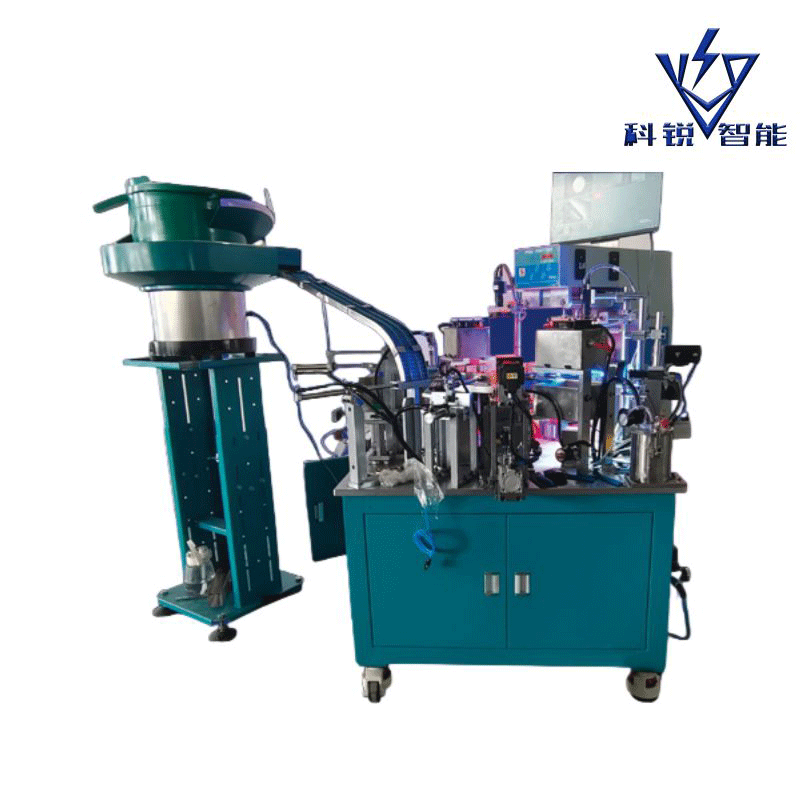
Industry demand upgrade: High-end stationery has driven a transformation in printing technology
According to data from the China Stationery, Educational and Sports Goods Association, the market size of high-end stationery in China is expected to exceed 60 billion yuan in 2025, among which the growth rate of customized pen products will exceed 35%. Consumers' demands for pen holders have shifted from "single logo printing" to "complex patterns, multi-color overprinting, and three-dimensional textures". However, traditional pad printing machines have three major pain points: large manual positioning errors (with an average error of over 0.3mm), resulting in a pattern offset rate exceeding 8%. Multi-color overprinting requires repeated adjustments of workstations, resulting in low production efficiency (only 300 to 500 pieces per hour). It cannot adapt to irregularly shaped pen barrels such as round and conical ones, which limits the design space of the product.
The emergence of high-end pen barrel visual positioning pad printing machines has precisely solved these problems. Data from the stationery equipment procurement platform shows that in the third quarter of 2025, the order volume of such equipment increased by 220% year-on-year. Among them, the purchase proportion of high-end pen manufacturers reached 58%, and the purchase growth rate of custom stationery manufacturers exceeded 280%. Previously, when we produced high-end pens, due to manual positioning errors, 10% of the products in each batch were scrapped because of pattern deviation. After switching to a visual positioning pad printing machine, the error was controlled within 0.05mm, and the scrapping rate dropped below 0.5%. Mr. Wang, the production manager of Parker in China, said.
It is worth noting that the explosive growth of "cultural and creative IP co-branded pens" has further driven up the demand for such devices. A person in charge of a stationery enterprise disclosed that for the co-branded pens in collaboration with ips such as the Forbidden City and Dunhuang, fine patterns need to be printed on the pen shafts, which is difficult for traditional equipment to achieve. However, the precise printing capability of high-end visual positioning pad printing machines has shortened the production cycle of such products from 15 days to 5 days.
Core technology breakthrough: Four major advantages define the new standard for printing
The high-end pen holder visual positioning pad printing machine can lead the industry transformation because of its all-round breakthroughs in visual recognition, positioning calibration, printing technology and other aspects, completely changing the traditional production mode:
AI visual recognition achieves "millimeter-level" precise positioning
The device is equipped with a 20-megapixel industrial camera and AI vision algorithms, which can capture the outline of the pen barrel and the position of the reference point in real time, automatically identify the material (metal, plastic, wood) and shape (circular, square, irregular) of the pen barrel, and generate a dedicated printing path. Even if the pen barrel is slightly deformed or tilted, the system can complete the error analysis within 0.1 seconds. By adjusting the pen barrel position through the mechanical arm, the positioning accuracy reaches ±0.03mm, far exceeding the industry average standard of 0.1mm.
When we produce conical pen barrels, traditional equipment requires manual adjustment of the Angle, taking 10 seconds for each one. Now, the visual system automatically recognizes the taper and completes the positioning instantly, increasing efficiency by 10 times. Ms. Li, the supervisor of the Deli Stationery production line, provided feedback. In addition, the device also supports "batch positioning memory", eliminating the need for repeated calibration of pen barrels in the same batch and further enhancing efficiency.
Automatic calibration for multi-color overprinting, saying goodbye to "manual repeated debugging"
To address the challenge of multi-color overprinting, this equipment adopts the "dynamic overprinting calibration technology" : after the first color is printed, the visual system captures the position of the pattern in real time, compares it with the preset parameters, automatically calculates the deviation value, and then adjusts the printing station of the next color to achieve "calibration immediately after printing". Whether it is a two-color logo, a four-color gradient pattern, or an eight-color complex design, all can be overprinted in one go, with an overprinting accuracy of 0.08mm, and no manual intervention is required.
The person in charge of a certain custom stationery manufacturer introduced: "Previously, to print three-color cartoon pattern gel pens, three workers were needed to adjust the red, yellow and blue workstations respectively, and only 400 pens could be printed per hour. Now, with the visual positioning pad printing machine, the overprinting is automatically completed, and 1,200 pens can be printed per hour, saving the labor cost of two workers." Third-party tests show that the pass rate of multi-color overprinting of this device reaches 99.2%, which is 30 percentage points higher than that of traditional equipment.
Irregular-shaped pen barrel adaptation, unlocking new possibilities in design
Traditional pad printing machines can only handle regular cylindrical pen holders, while high-end visual positioning pad printing machines, through the combination of "3D contour scanning + flexible printing head", can easily adapt to irregular-shaped pen holders: the 3D scanning module acquides the three-dimensional data of the pen holder and generates a printing trajectory that conforms to the surface. The flexible silicone rubber printing head can deform along with the arc of the pen barrel, ensuring uniform ink coverage. Even for complex pen barrels with grooves and patterns, it can achieve seamless printing without blind spots.
At present, this equipment has been successfully applied in the production of special categories such as wooden fountain pens, metal engraved pens, and silicone grip pens. The metal pen with spiral pattern that we launched was previously in the research and development stage due to the inability to print precisely. Now, with this device, we can clearly print gradient logos on the spiral pattern. After the product was launched, its sales exceeded 100,000 units. Mr. Zhang, the founder of a certain emerging stationery brand, said.
Intelligent data management ensures full traceability throughout the production process
The equipment is connected to the industrial Internet platform, which can record the printing parameters of each pen (positioning error, ink usage, printing time) in real time and generate a dedicated "production file". Managers can view production progress, pass rate and equipment status through their mobile phones or computers. They can also export data reports with one click, which is convenient for quality control and order traceability. In case of printing problems, the system can quickly trace back the parameters, locate the cause of the fault, and reduce downtime.
Previously, a customer reported that the patterns on a certain batch of pens were blurry. It took us three days to find out that it was due to abnormal ink viscosity. Now, through data reports, we can locate the problem in just one minute, significantly improving efficiency. Ms. Chen, the quality director of a stationery enterprise, said.
Application scenario expansion: From high-end manufacturing to popularization among small and medium-sized manufacturers
The application scenarios of high-end pen holder visual positioning pad printing machines are constantly expanding, gradually spreading from the high-end production lines of leading brands to small and medium-sized stationery manufacturers. To lower the procurement threshold for small and medium-sized manufacturers, equipment manufacturers have launched a "leasing + installment payment" model and also offer free operation training and technical support to help small and medium-sized enterprises quickly master the usage methods of the equipment.
In the field of high-end pen manufacturing, this equipment is used to print fine patterns and brand logos, enhancing the added value of the products. In the field of custom stationery, it supports small-batch (minimum order of 100 pieces) personalized printing to meet the customization needs of corporate gifts, campus cultural and creative products, etc. In the field of cross-border e-commerce, it helps manufacturers respond quickly to overseas orders, such as producing pen products with festival patterns for the European and American markets, and shortening the delivery cycle.
The person in charge of a certain foreign trade stationery manufacturer disclosed: "Previously, when taking orders for custom pens from Europe and America, due to low production efficiency and poor pass rate, we were reluctant to accept small-batch orders. Now, with the use of visual positioning pad printing machines, even small orders of 500 pieces can be profitable. The volume of cross-border orders has increased by 60%." "
Future trend: The coordinated development of intelligence and greenness
With the continuous iteration of technology, high-end pen visual positioning pad printing machines are developing in two major directions: In terms of intelligence, the next-generation equipment will incorporate the "AI quality inspection" function, automatically identifying pattern defects (missed printing, blurring, color difference) after printing, achieving an integrated process of "printing - inspection - sorting". In terms of green development, the equipment will adopt an environmentally friendly ink circulation system to reduce ink waste. At the same time, it will optimize the drying process to lower energy consumption, meeting the development needs of "sustainable production" in the stationery industry.
Industry analysts point out that the emergence of high-end pen holder visual positioning pad printing machines not only enhances the precision and efficiency of pen holder printing but also promotes the transformation of stationery manufacturing from "labor-intensive" to "technology-intensive". In the future, as the cost of the equipment gradually decreases and the technology further matures, it is expected to become a "standard equipment" in the stationery industry, helping more enterprises create high-quality and personalized pen products and promoting the entire industry to develop towards higher quality.


