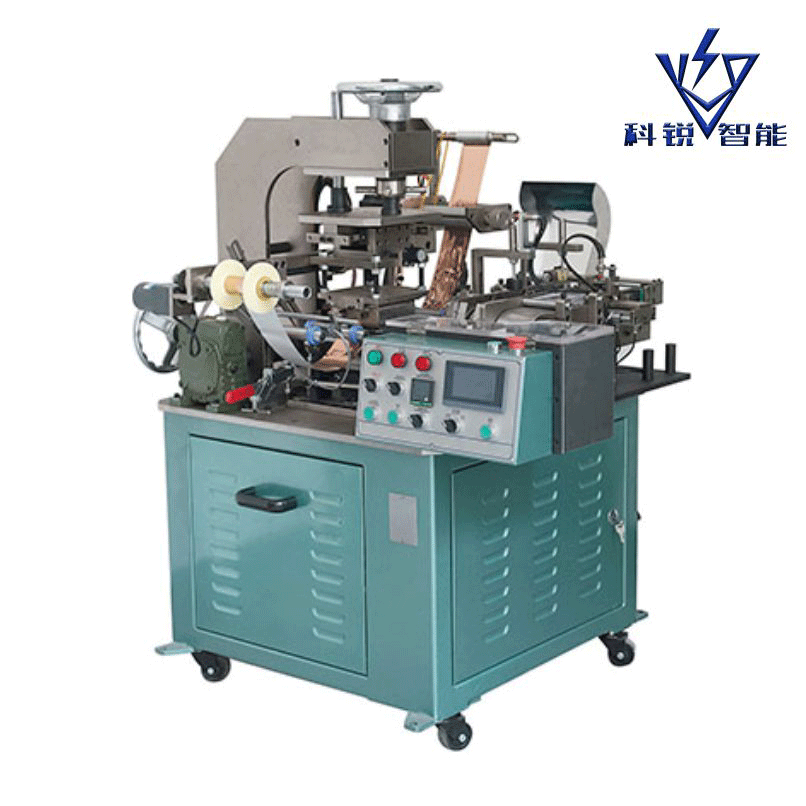
The benefits of hot stamping and transfer machines in production
1. Enhancing Production Efficiency to Adapt to Large-Scale Mass Production
Hot stamping and transfer machines (especially automated models) significantly shorten the processing cycle and meet the needs of batch production. Their core advantages are reflected in:
-
High-Speed Continuous ProcessingAutomated hot stamping machines (such as rotary hot stamping machines) can realize a continuous workflow of "feeding-positioning-hot stamping-receiving", with a speed of 300-1000 cycles per minute (adjusted according to product size) — far exceeding traditional processes like manual labeling and screen printing. Transfer machines (e.g., heat transfer, water transfer) can complete large-area pattern transfer in one go, avoiding time consumption from overlapping multiple processes.
-
Precise Positioning to Reduce Rework RateModern equipment is equipped with technologies such as CCD visual positioning and servo motor control, enabling positioning accuracy to be controlled within ±0.1mm. This effectively prevents issues like pattern offset and double images, reduces production delays caused by defective products, and indirectly improves overall efficiency.
-
Strong Automated Integration CapabilityThey can be seamlessly connected to production lines (e.g., packaging lines, garment printing lines) to achieve integration of "pre-processing-surface decoration-post-processing cutting". No manual handling or secondary positioning is required, greatly reducing breakpoints in the production process.
2. Optimizing Process Effects to Increase Product Added Value
Hot stamping and transfer technologies can achieve decorative effects that are difficult to attain with traditional processes, helping products gain a competitive edge in appearance:
-
Hot Stamping: High-End Texture HighlightHot stamping (e.g., gold, silver, laser, matte foil stamping) can create three-dimensional embossed effects, metallic luster, or special textures (such as brushed or frosted finishes) on paper, plastic, and metal surfaces. It is commonly used in high-end gift boxes, cosmetic packaging, and wine labels, instantly enhancing the "high-end feel" of products. Additionally, the hot-stamped layer is wear-resistant and scratch-resistant, with no easy fading during long-term use.
-
Transfer: Realizing Complex Patterns and Full-Wrap Decoration
- Heat Transfer: It can transfer high-precision color patterns (e.g., photo-level patterns, gradient colors) to irregular curved surfaces (such as thermos cups, mice, and toys), solving the problems of "curved surface missing printing" and "color limitations" in screen printing.
- Water Transfer: It can achieve "full-wrap" pattern coverage (e.g., guitar bodies, automotive interior parts) and simulate natural textures like wood grain, marble, and carbon fiber. The effect is realistic, and the cost is lower than that of real materials.
- Cold Transfer: Suitable for heat-sensitive materials (e.g., PVC, PE films), it avoids material damage caused by high temperatures while maintaining the vividness of pattern colors.
-
Eco-Friendly and Odorless, Meeting Compliance RequirementsMainstream hot stamping foils (e.g., eco-friendly PET-based foils) and transfer films do not contain harmful substances such as benzene compounds and heavy metals. The processing process produces no waste gas or wastewater emissions, complying with environmental standards like the EU REACH and China’s GB 9685. They are especially suitable for fields with high safety requirements, such as food packaging and children’s products.
3. Controlling Comprehensive Costs to Lower Production Thresholds
Compared with processes like screen printing, spraying, and engraving, hot stamping and transfer machines have more advantages in the full-cycle costs of "initial investment-consumables-maintenance":
| Cost Dimension | Advantages of Hot Stamping/Transfer Machines |
|---|---|
| Initial Equipment Cost | Small desktop machines (suitable for small-batch production) cost only a few thousand yuan. Although large automated machines cost tens of thousands of yuan, the unit cost can be diluted through mass production, and the equipment service life is as long as 5-10 years. |
| Consumables Cost | The unit area cost of hot stamping foils and transfer films is low (e.g., 1m² of gold stamping foil can cover thousands of small labels), and there is no "ink waste" (screen printing requires ink preparation, and unused ink is prone to solidification). |
| Labor & Maintenance Cost | Automated equipment only requires 1-2 operators and no professional technicians. The equipment has a simple structure (core components are heating rollers and pressure devices), and daily maintenance only involves cleaning and replacing vulnerable parts (e.g., hot stamping heads), resulting in low maintenance costs. |
| Trial Production Cost | Pattern replacement only requires changing the hot stamping plate/transfer film, without remaking screen printing plates or engraving molds (traditional process plate replacement takes several days and costs hundreds of yuan). The trial production cycle is shortened to a few hours, making it suitable for "multi-variety, small-batch" orders. |
4. Strong Compatibility for Multiple Industries and Materials
Hot stamping and transfer machines have strong compatibility with processed materials, covering almost all common solid materials in industrial production. There is no need to replace equipment for different materials, making them applicable to a wide range of scenarios:
- Packaging Industry: Paper (gift boxes, cigarette packs), plastic films (food bags, cosmetic bags), metal cans (milk powder cans, beverage cans);
- Textile Industry: Garment fabrics (cotton, polyester, nylon), luggage accessories (leather, PU), socks (heat transfer labels);
- Electronics Industry: Mobile phone cases (PC/silicone materials), charger housings (ABS plastic), circuit boards (hot-stamped character marks);
- Daily Necessities Industry: Ceramics (cups, tableware), glass (wine bottles, cosmetic bottles), wood (furniture panels, toys);
- Automotive Industry: Interior parts (instrument panels, door trim panels), exterior parts (wheel covers, body stickers).